Certified Randomness and Live Video Synchronization in Remote Wheel Gaming Systems
Written by Blake Lorenz · Aug 13, 2026
Certified Randomness and Live Video Synchronization in Remote Wheel Gaming Systems
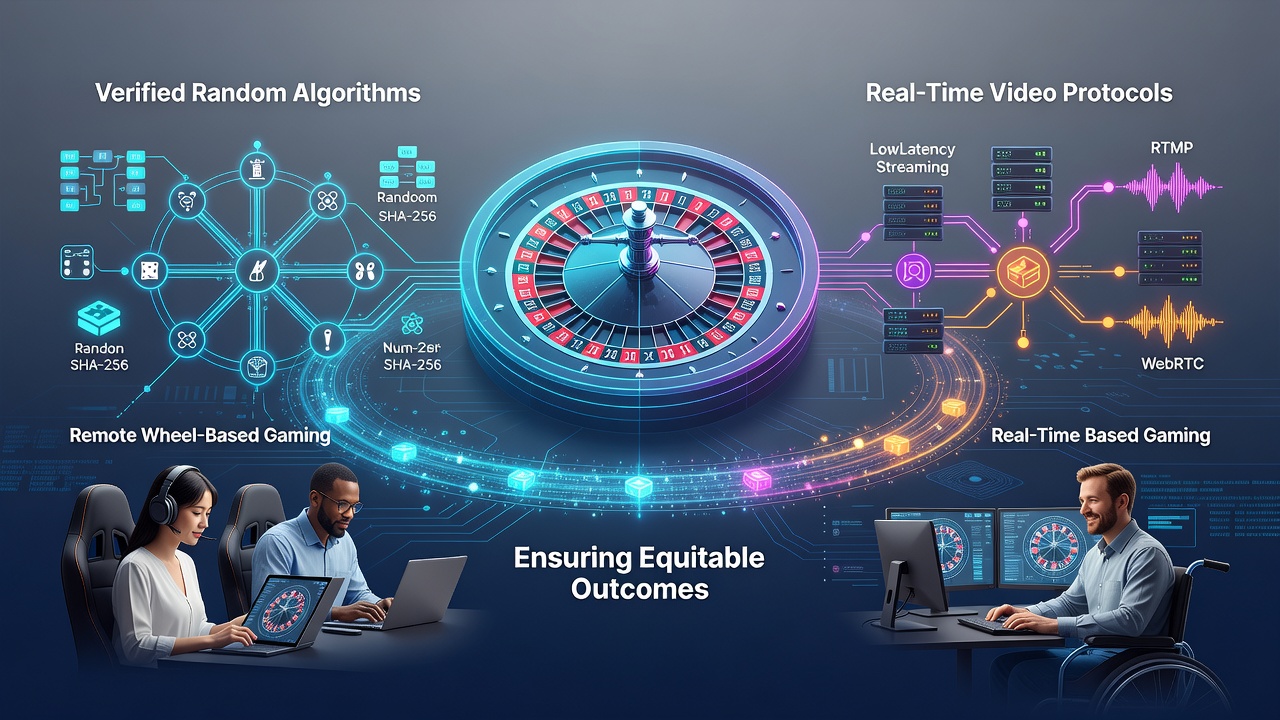
Remote wheel-based gaming relies on two core technical layers that operate in tandem, and observers note how verified random algorithms pair with real-time video protocols to support consistent outcome distribution across distributed networks. Certified random number generators undergo third-party evaluation against established statistical test suites, while video streams capture physical wheel rotations with frame-accurate timestamps that allow independent verification of each spin sequence.
Random Algorithm Certification Standards
Certification bodies apply suites such as those maintained by the National Institute of Standards and Technology to confirm that algorithmic outputs pass tests for uniformity, independence, and unpredictability before deployment. Data from these evaluations show that generators meeting the SP 800-90 series criteria produce sequences that resist pattern detection across millions of trials, and operators integrate hardware security modules to protect seed values from external interference. In August 2026 several international laboratories introduced updated validation frameworks that incorporate post-quantum cryptographic primitives, extending the lifespan of existing certification cycles for wheel gaming platforms.
Real-Time Video Protocol Requirements
Video transmission systems employ low-latency codecs and synchronized clock references so that each frame of a spinning wheel aligns with the corresponding random draw timestamp. Protocols built on RTP and SRT deliver packets with sub-frame jitter control, and receivers reconstruct the sequence using embedded metadata that includes wheel position markers and checksum values. Research from academic groups at technical universities indicates that these synchronized streams reduce the window for post-generation manipulation because any alteration to recorded footage would break the cryptographic chain linking the random seed to the visual result.
Interplay Mechanisms Between the Two Layers
Systems combine the outputs of certified generators with live video feeds through a process that binds each algorithmic result to a specific video segment via hash chaining. One implementation hashes the random value together with frame hashes from the video buffer, then publishes the composite digest to a public ledger where third parties can audit the match after the fact. This binding prevents substitution of either the random number or the visual record without detection, and figures from industry test reports reveal that such combined verification catches discrepancies at rates exceeding 99.999 percent across sampled sessions.

Network monitoring tools continuously sample both streams, and discrepancies trigger automated alerts that pause play until operators resolve the mismatch. European regulatory frameworks outside the United Kingdom require these monitoring logs to be retained for a minimum period, enabling subsequent forensic review by accredited auditors.
Geographic and Regulatory Variations
Canadian provincial regulators and Australian state authorities maintain separate certification pathways that emphasize different statistical thresholds yet converge on the requirement for dual-layer verification. Observers note that platforms serving multiple jurisdictions therefore maintain parallel audit trails, each tailored to the local technical specifications while preserving the core hash-binding architecture. Industry associations such as the European Gaming and Betting Association publish comparative studies that document how these regional approaches affect latency budgets and video resolution standards without altering the fundamental fairness guarantees.
Future Protocol Developments
Work continues on embedding machine-readable proofs directly into video containers so that verification occurs at the client device without requiring a central authority. Early prototypes released in 2026 demonstrate that zero-knowledge proofs can confirm both the random generation step and the video integrity in a single compact attestation, and researchers continue to measure the computational overhead introduced by these proofs on consumer-grade hardware. Data collected during pilot deployments indicate that proof sizes remain under 2 kilobytes per spin while verification completes in under 50 milliseconds on standard mobile processors.
Conclusion
The combination of independently certified random algorithms and timestamp-synchronized video protocols creates a verifiable chain that supports equitable outcome distribution in remote wheel-based gaming. Ongoing refinements to cryptographic standards and streaming technologies continue to tighten the linkage between algorithmic results and visual records, and regulatory bodies across multiple regions maintain oversight through periodic re-certification and log audits. These technical measures operate continuously to preserve the integrity of each game cycle across expanding global networks.